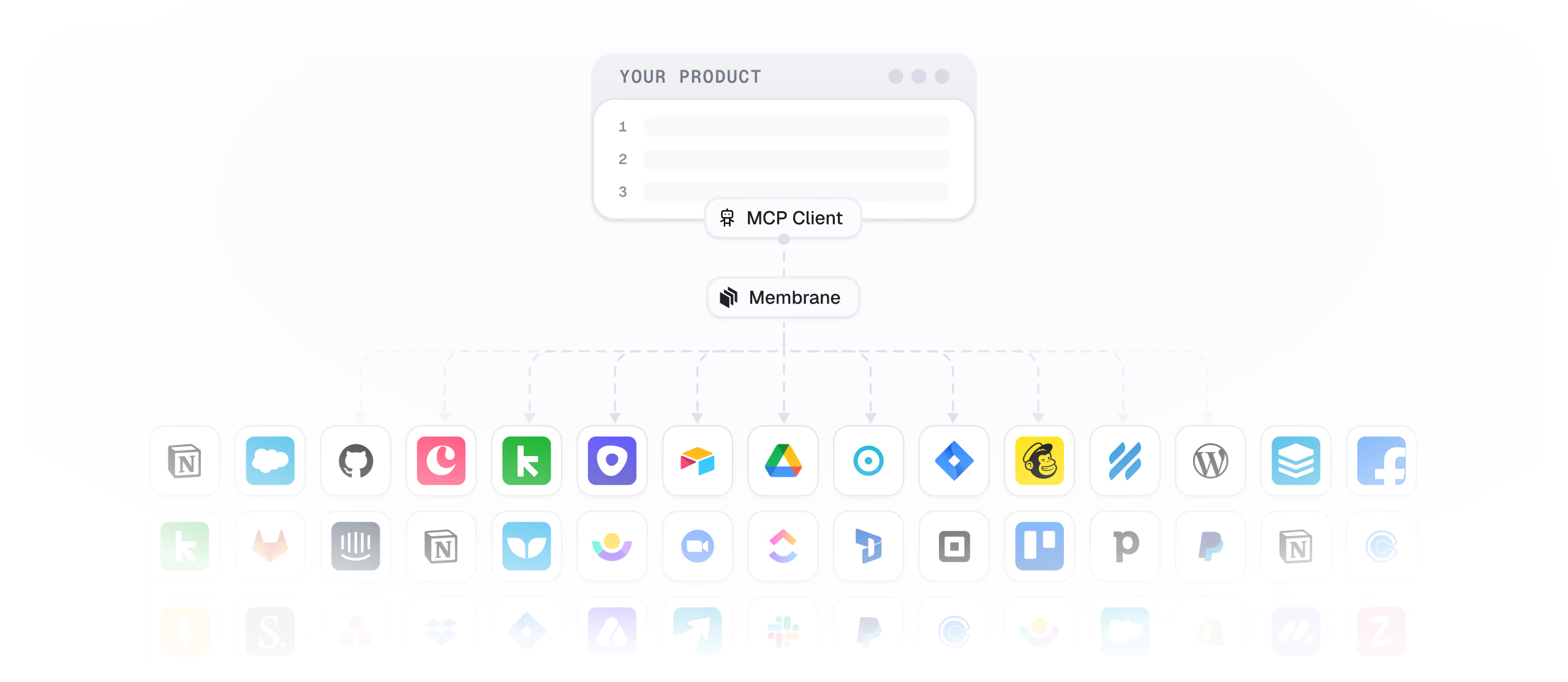
Integration expectations are changing
Today’s users expect their favorite SaaS tools to “just work together.” Increasingly, they also expect AI agents to help manage those connections — handling tasks across apps, surfacing insights, and taking action on their behalf.
But traditional SaaS integrations are time-consuming to build and brittle to maintain. Building a direct connection to every app your users want? Not scalable.
That’s where MCP comes in.
What is MCP?
The Model Context Protocol (MCP) is an open protocol that bridges the gap between AI applications (like LLM-powered agents) and the world of tools and data they need to access — especially within the SaaS ecosystem.
At its core, MCP provides a standardized way for agents to discover, access, and invoke external tools, regardless of where they live or how they’re built.
It follows a client-server architecture:
- MCP Servers expose capabilities as standardized “tools.”
- MCP Clients (often embedded in AI apps or agents) connect to these servers, discover available tools, and invoke them.
- MCP Hosts are environments like Claude Desktop, IDEs, or custom agents that use MCP clients to access tools.
Because MCP is modular, you can add new tools dynamically without changing anything about the AI application itself.
Why MCP matters: a universal agent-tool interface
The future of SaaS and AI agents isn’t just about answering questions, t’s about taking action.
To do this well, agents need to:
- Discover tools dynamically, based on the user’s context and connected accounts.
- Invoke actions across apps (e.g. send an email, create a calendar event, update a CRM record).
- Manage permissions and security in a consistent, auditable way.
MCP makes this possible by giving agents a universal “language” for interacting with tools. With MCP, agents can:
- Orchestrate workflows across multiple SaaS apps
- Adapt instantly as new integrations become available
- Deliver a seamless, action-oriented experience to users
A practical example
To see MCP in action, check out our AI Agent Example, powered by the Membrane MCP server. This server exposes all actions from Membrane as MCP tools. Key features of our MCP Server:
- Easy setup: Deploy locally or remotely, and connect to your agent with Membrane credentials.
- Dynamic tool selection: Only relevant tools are enabled based on the user’s query.
- Session management: Persistent chat sessions maintain context across interactions.
- Security: Access is secured and auditable via Membrane tokens.
This setup lets developers and product teams:
- Access thousands of SaaS integrations as tools
- Dynamically invoke the right one based on user requests
- Scale with new integrations — no additional engineering required
Conclusion
MCP is redefining how SaaS apps integrate — not through brittle point-to-point connections, but by enabling AI agents to act intelligently across an open ecosystem of tools.
For integration owners and product teams, adopting MCP means building agents that are more capable, more adaptable, and easier to scale.
Ready to try it? The Membrane MCP Server is a practical, open-source way to start — and it works out of the box with thousands of integrations.
Fully operational reference implementation of an AI Agent
Knowledge Import
Workflow Builder
Dynamic Tool Usage


